Introduction to Psychology of Consciousness
Goran Kardum
Course description
Interdisciplinary, drawing on material from philosophy, psychology, neuroscience, cognitive science, religion and artificial intelligence
Content, topics
- Definition of consciousness
- What is consciousness?
- History of consciousness
- Methodology / research of consciousness
- The philosophical foundations of consciousness science
- Neuroscience / neuropsychology of consciousness
- Empirical theories of consciousness
- Sleep and dreaming
- Meditation, contemplation, religion and consciousness
- Altered states of consciousness
- Mental disorders and consciousness
- Psychoactive substances and consciousness
Why Psychology of Consciousness
- one of the most important topics for the twenty-first century.
- combines the best of psychology, neuroscience, and philosophy, as well as requires other disciplines and natural sciences (physics, chemistry, and biology).
- is the most mysterious of all things
- consciousness by its very nature is subjective (qualia).
- we exist within our consciousness, and so do all thoughts / investigations of consciousness.
Why Psychology of Consciousness
- investigation of consciousness absolutely requires a complex and integrative approach blending many fields of study and scholarship
- I think, therefore I am? (Anglin, 2014)
- Consciousness itself, of course, is the most mysterious of all things that we contend with as human beings (Hashim & Alexiou, 2022).
Definition of consciousness
- consciousness by its very nature is difficult to define
- we can start and explore/deal with historical definitions.
- it is also interesting to consider consciousness from various scholars including philosophers, theologians, biologists, and even those who pur- sue artificial intelligence.
- different type of definition for consciousness are more practical and some other are esoteric.
- from scientific point of view, we also have to consider a more operationalized perspective.
Different definitions
- does not exist unify definition
- dichotomy between reductionism and antireductionism
- does it mean self-consiousness
- some definition articulate integration of information (binding);
- some definition connect consciousness and awareness or consciousness and will (one of the hard problem - free will)
Dimensional definition
- Consciousness as sensory consciousness
- Consciousness as selective attention
- Consciousness as inner consciousness
- Consciousness as self integrity, experience of self
- Consciousness as a state of alertness
Different methodology
- operacionalisation of concepts
- measuring of consciousness
- different experimental models
- clinical or case studies
What is consciousness?
- Consciousness describes our awareness of internal and external stimuli.
- Awareness of internal stimuli includes feeling pain, hunger, thirst, sleepiness, and being aware of our thoughts and emotions.
- Awareness of external stimuli includes seeing the light from the sun, feeling the warmth of a room, and hearing the voice of a friend.
History
- John Locke (1632–1704)
- Rene Descartes
- Cartesian Dualism
- Sigmund Freud
- Modern theories about consciousness
Sleep and wakefulness
- awakening, consciousness, brain waves
- EEG and polysomnography
- sleep stages (REM, NREM stages)
- sleep and circadian rhytm
- parasomnias (REM Sleep Behavior Disorder (RBD), Recurrent Isolated Sleep Paralysis, Nightmare Disorder, Exploding Head Syndrome, Sleep-Related Dissociative Disorder, Sleep-Related Hallucinations)
- sleep related movement disorders (Restless Legs Syndrome (RLS), Periodic Limb Movement Disorder (PLMD), Sleep-Related Bruxism, Sleep-Related Rhythmic Movement Disorder)
- dream, wakefulness and sleep connection
The hard problem
“Consciousness is at once the most obvious and the most difficult thing we can investigate.” (Blackmore, 2018)
“How on earth can the electrical firing of millions of tiny brain cells produce this—my private, subjective, conscious experience?”
“This problem is called the ‘hard problem’ of consciousness, a phrase coined in 1994 by the Australian philosopher David Chalmers. He wanted to distinguish this serious and overwhelming difficulty from what he called the ‘easy problems’.”
“American philosopher Patricia Churchland calls it a ‘hornswoggle problem’, arguing that we cannot, in advance, decide which problems will turn out to be the really hard ones.”
Why the mystery?
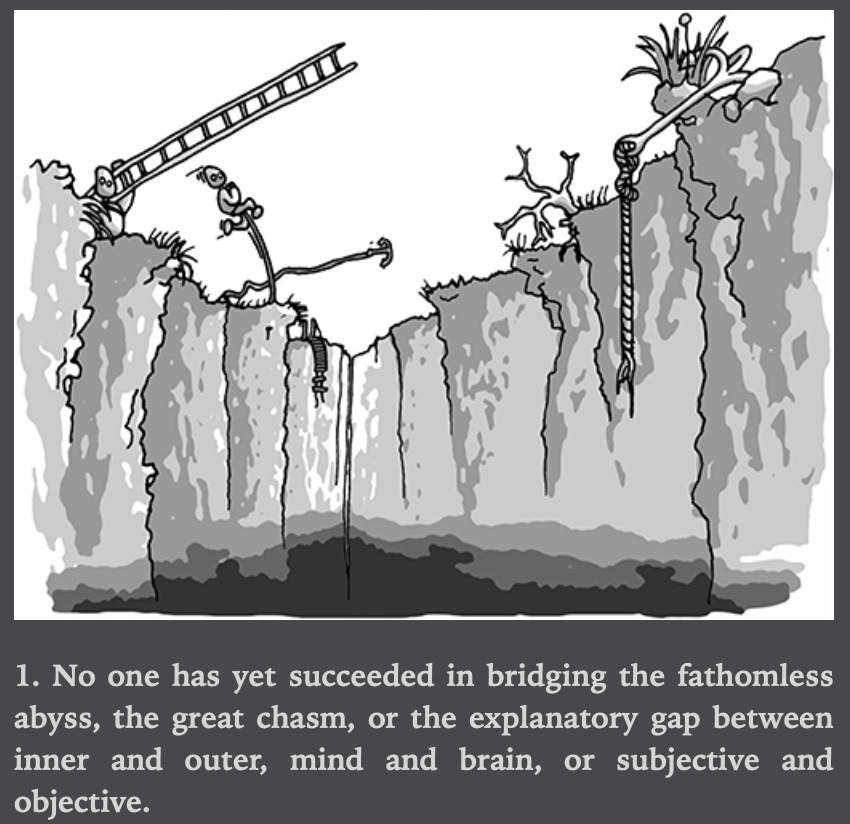
The Science of Subjective Experience
- The Science of Subjectivity (Revonsuo, 2010)
- To study consciousness is to study a deep mystery about ourselves.
- It is to study the nature of our existence, but not the kind of existence that physics and the other sciences study because they study the objective existence of atoms, galaxies, oceans, cells, time and space, among other things.
- To study consciousness is to study the fundamental nature of our personal existence, our subjective existence, our life as a sequence of subjective experiences.
- A conscious being has an internal psychological reality, a mental life consisting of subjective experiences, with a stream of consciousness flowing within.
- “The hard problem: How do subjective experiences arise from objective brains?”
The philosophical foundations of consciousness science
- Dualistic theories of consciousness
- Monistic theories of consciousness
- Mind-body problem and consciousness
- Empirical theories of consciousness
The historical foundations of concsiousness science
- Although the science of consciousness in its modern form emerged only recently (during the 1990s), the study of consciousness has its roots deep in the history of psychology
- Consciousness went through between the 1870s and the 1990s – during the roughly 120 years before the emergence of the current “new wave” of consciousness research.
The historical foundations of consciousness science
- The 1800s: From philosophy to experimental science of consciousness
- Wundt (1897) – science of immediate experience
- Titchener’s (1899) – science of mental processes
- Introspectionism: The first scientific psychology of consciousness
- From cognitive science to the science of consciousness
Conceptual foundations of concsiousness science
- How to describe the subjective reality of consciousness
- Concepts to describe the absence of consciousness
- Alternative definitions and usages of the concept of “consciousness”
Neural correlates of consciousness
- The answers to these rather fundamental questions depend on what the science of consciousness will find out about our subjective psychological reality and about its physical seat, our brain! (Revonsuo, 2010)
- The role of brain and other location in body for complex dimensions of consciousness
Altered states of consciousness
States that qualitative and quantitative different then normal state of wakefulness:
- dreaming during wakefulness
- sleep / dreaming
- meditation
- contemplation
- hypnotic trans
- possesion / obsession
- perception distortion according to different psychoactive substances
- psychopathology